


Stack Light Colors Explained: What Red, Yellow, Blue, Green and White Mean on a Signal Tower
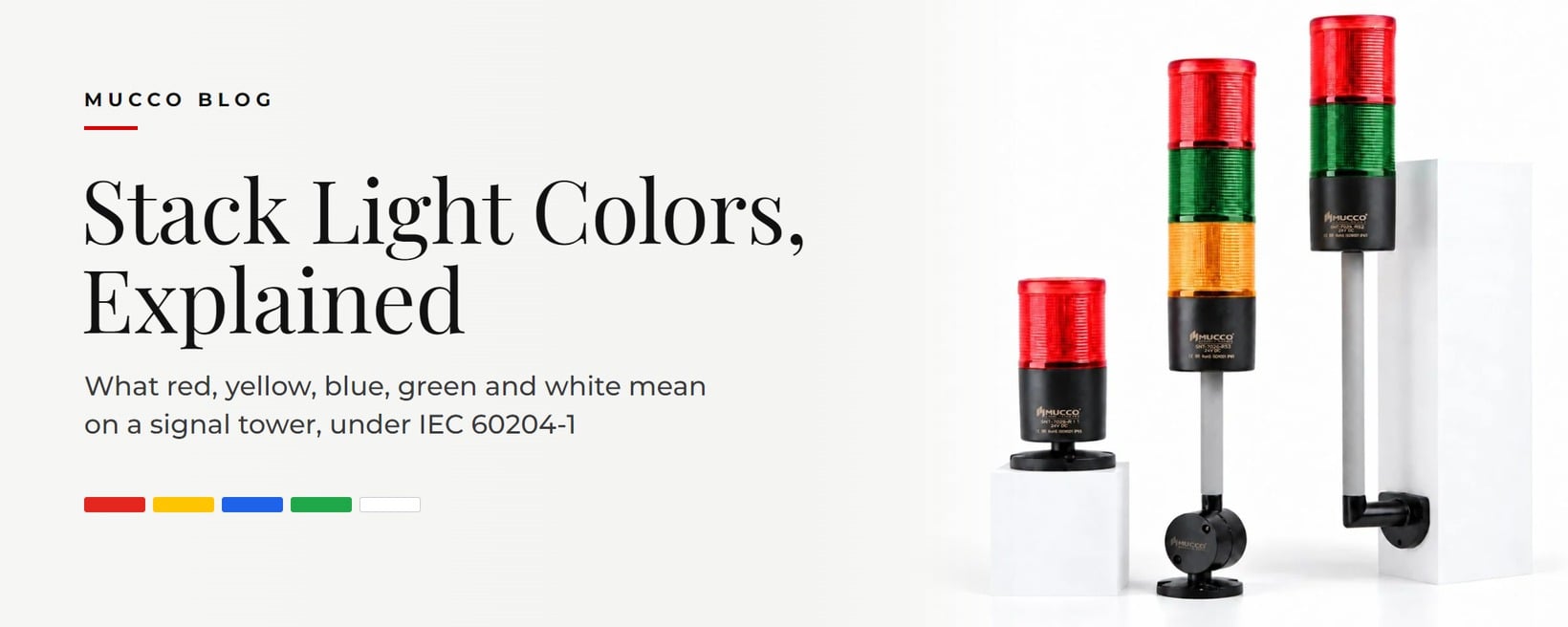
A stack light, also called a signal tower light, tower light, andon light veya machine status light, turns the condition of a machine into something a person can read from the other side of the hall. That only works when every operator, technician and supervisor reads the same stack light colors the same way. If red means “stopped on a fault” on one machine and “waiting for material” on the next, people learn to ignore the tower, and the one signal that matters gets missed.
This guide explains what each signal light color means under IEC 60204-1, the order the layers should follow, when a light should be steady or flashing, when to add sound, and how to set a color convention that holds across a whole plant. Where research on human perception helps, we cite it, and every source is listed at the end.
Stack light colors at a glance
IEC 60204-1, the international standard for the electrical equipment of machines, assigns a meaning to each indicator light color based on the condition of the machine[1]. The same meanings apply to the layers of a stack light or LED tower light.
| Renk | Meaning | Condition of the machine | What the operator does | Tipik bir örnek |
|---|---|---|---|---|
| Kırmızı | Emergency | Hazardous condition | Acts immediately | Fault stop, emergency stop actuated |
| Yellow (amber) | Abnormal | Abnormal or impending critical condition | Monitors or intervenes | Material running low, temperature approaching a limit |
| Mavi | Mandatory | A condition that requires operator action | Carries out the required action | Reset required, material call, quality check due |
| Yeşil | Normal | Normal condition | Optional | Running in automatic mode |
| Beyaz | Neutral | Any other condition | Monitors | Power on, cycle complete, user-defined status |
White is the fallback. The standard allows it whenever there is doubt about which of the other four applies. Amber and yellow are used interchangeably on most towers; what matters is that the lens is clearly distinct from red and green at the viewing distance.
What is a stack light, and what is it called around the world?
A stack light is a column of colored light modules mounted on or near a machine, often with an optional buzzer. The name changes by region and industry, which matters when you search for products or write specifications:
- Sıra ışığı veya stacklight: common in North America and in automation catalogs.
- Signal tower, signal tower light veya tower light: common in Europe and Asia.
- Light tower veya LED tower light: often used by machine builders and in tender documents.
- Andon lambası: used in lean manufacturing, where the tower is part of an andon system that calls for help at a workstation.
- Machine status light, indicator tower veya warning light tower: descriptive terms used in maintenance and safety documents.
- Indicating tower: the term used in IEC 60204-1 itself.
All of these describe the same device. Mucco builds them as fixed three-layer stack lights, five-layer stack lights and configurable modüler istif lambaları.
Where these meanings come from
IEC 60204-1 covers the electrical equipment of machines, including indicator lights and displays[1]. Its color table follows the general coding principles of IEC 60073, which sets how colors and other codes are used for indicators and actuators so that the same signal means the same thing across equipment[2]. In North America, NFPA 79 contains comparable guidance for industrial machinery.
Two points are worth knowing before you apply the table:
- The table describes the condition of the machine. It links each color to how urgent the situation is and what the person in front of the machine should do.
- It is a default. Many plants add their own conventions on top, particularly for andon and production monitoring. That is acceptable as long as the convention is consistent, documented and does not contradict the safety meaning of red.
Color coding is one of the oldest tools of visual management. A review of the visual management literature in production by Tezel, Koskela and Tzortzopoulos groups it with other visual tools whose purpose is to make the state of a process visible, so that people can act without asking[7]. A stack light is a small, very direct example of that idea.
The order of the layers
IEC 60204-1 recommends that indicating towers on machines carry their colors in this order from the top down[1]:
- Kırmızı
- Sarı
- Mavi
- Yeşil
- Beyaz
The logic is simple. The most critical signal sits highest, where it clears guards, enclosures and neighboring equipment and can be seen from farthest away. Position also becomes a second code. An operator who cannot tell red from green at a distance still knows that the top layer means trouble.
A three-layer tower follows the same rule with the colors it uses: red on top, yellow in the middle, green at the bottom. A four-layer tower adds blue between yellow and green.
Why position matters: color vision deficiency
Position is not a nicety. A worldwide review by Birch found that about 8% of men and 0.4% of women of European descent have an inherited red-green color deficiency, and between 4% and 6.5% of Chinese and Japanese men[3]. On a shift of 25 men, that is typically one or two people who may confuse the red and green layers. A fixed layer order lets them read the tower by position, and it is the main reason not to rearrange colors from machine to machine.
Steady or flashing?
A steady light describes a state. A flashing light asks for attention. IEC 60204-1 describes flashing as a way to add emphasis, for example to[1]:
- attract attention
- request immediate action
- show a discrepancy between the commanded state and the actual state
- show that a change is in progress
The standard also recommends reserving faster flash rates for higher-priority information.
Research on visual monitoring supports this. In a study for the US Federal Aviation Administration, Thackray and Touchstone measured how quickly people noticed new targets on a display while doing another task. Flashing targets were found in an average of 5.3 seconds, compared with 18 seconds for targets marked by shape alone and 10.4 seconds for color alone. Flashing targets were also detected equally fast under high and low workload and at the edge of the display, while steady targets were not[4]. The authors also warn that flashing distracts, which is the practical reason to keep it for the signals that deserve it.
In practice, the fewer signals that flash, the more each one means. A common pattern is flashing red for a new fault that nobody has acknowledged, and steady red once someone has acknowledged it, until the cause is cleared. Mucco 50 Series modular stack lights offer steady, flashing, fast flashing and strobe modes, so the same tower can follow this pattern.
Brightness and visibility
How visible a light is depends far more on its effective intensity than on its color. In psychophysical tests of flashing warning lights at the US National Bureau of Standards, Howett found that the conspicuity ranking of 39 light configurations correlated with measured effective intensity at r = 0.90. In daylight, white and yellow lenses ranked higher than red and blue, mainly because colored filters let less light through[5].
For a stack light, that has two consequences. First, check that the red layer is bright enough for the ambient light where the machine stands, because red is often the dimmest lens. Second, mount the tower where it is seen against a plain background and not against windows or bright overhead lighting.
When to add sound
Light only works when someone is looking. If the operator works with their back to the machine, tends several machines at once, or is away from the line for part of the cycle, add an audible signal to the conditions that need a fast response. In most cases that is the red layer. A buzzer module on the tower or a separate LED uyarı kornası covers this.
Two findings from warning research are worth applying. Patterson’s guidelines for auditory warnings recommend a level at least 15 dB above the masked threshold set by the background noise, and not much more, because warnings that are too loud startle people and disrupt communication[8]. And in a study of alarm handling, Stanton and colleagues found that operators detected alarms significantly worse when alarms arrived at one per second than at one every four or eight seconds[6]. Keep sound for the events that deserve it. A buzzer that sounds for every minor warning gets silenced or taped over. When you compare sound levels between products, check the distance at which each figure was measured.
What the standard leaves to you
The standard gives you five meanings. It does not tell you which events on your packaging line or CNC cell belong under each one. That mapping is the plant’s job, and it is where most confusion starts.
A convention that works on many shop floors looks like this:
| Renk | Plant convention |
|---|---|
| Kırmızı | Machine stopped by a fault or a safety function |
| Sarı | Warning: the machine is running but will stop without intervention |
| Mavi | Call for support: material, maintenance or quality |
| Yeşil | Running in automatic mode |
| Beyaz | Powered and idle, or a status specific to the process |
Whatever you choose, apply three rules:
- Use one meaning per color across the whole plant, including machines from different suppliers.
- Write it down. Put a legend where operators can see it, and add the convention to machine documentation and operator training.
- Do not rely on color alone. Keep the layer order identical on every machine so that position carries the message as well.
Andon lights and stack lights
In lean manufacturing, an andon system lets an operator signal a problem and call for help, and the tower above the workstation shows that call to the team leader. The colors usually follow the same logic: red for a stopped station, yellow for a call that is still being handled, green for normal running, and blue for a material or quality call. A ready-made LED andon kit stack light combines the tower with the push buttons needed at the station. For how andon fits into visual management, see our guide to industrial andon systems.
Common mistakes
- Red for a normal stop. If red lights up every time a machine finishes a batch or waits for a part, operators stop reacting to it. Keep red for conditions that need immediate action.
- Different meanings on neighboring machines. Machines from different builders often arrive with different conventions. Align them during commissioning.
- Too much flashing. When three towers flash at once, none of them stands out.
- Green on top. It looks tidy, but it puts the least urgent signal in the most visible position.
- Five layers when three would do. Every extra color is one more meaning for people to remember. Add blue or white only when you have a clear use for them.
- A tower hidden by the machine. Check sight lines from where operators and supervisors actually stand, and use an extension tube or wall bracket if needed.
How many layers do you need?
Most machines are well served by three layers: red, yellow and green. Add blue when operators need a way to call for material, maintenance or a quality check without stopping the machine. Add white when you need a status that fits none of the others, which brings you to a five-layer stack light.
Where space is tight, a multicolor RGB stack light or an RGB warning light can show several colors from a single housing. It saves height, but it gives up position as a second code, so the legend and operator training matter even more. For a single status, such as “machine running” on a conveyor, a sinyal işaretçisi is often enough.
What to specify when you order a stack light
Before you request a quotation, note down:
- Number of layers and the color of each, from the top down
- Steady, flashing or strobe mode for each layer
- Whether you need a buzzer, and the required sound level at a stated distance
- Supply voltage, for example 24 V AC/DC or 85–250 V AC/DC
- Connection type: cable or M12 connector
- Mounting type: surface, foldable base, wall bracket or nut connection, and whether an extension tube is needed
- Degree of protection required for the environment, for example IP65
The Mucco 50 Series Modular Stack Light with M12 8-pin connector offers steady, flashing, fast flashing and strobe modes, an optional 7-tone buzzer and IP65 protection. For other sizes and layer counts, see the full range of modüler istif lambaları. For mounting options, see our guide to stack lights and nut-mounted beacons.
Sıkça sorulan sorular
What do the colors on a stack light mean?
Under IEC 60204-1, red means emergency, yellow means abnormal, blue means mandatory operator action, green means normal and white means neutral or any other status.
What does a blue light mean on a stack light?
Blue means mandatory: a condition that requires the operator to do something, such as resetting the machine or loading material. Many plants also use blue as a call for support.
What order should stack light colors be in?
IEC 60204-1 recommends red, yellow, blue, green and white from the top down. If your tower uses fewer colors, keep the same relative order.
Is a signal tower the same as a stack light?
Yes. Stack light, signal tower, tower light, light tower, andon light and indicating tower all describe the same device: stacked colored light modules that show machine status.
Is the stack light color code mandatory?
IEC 60204-1 expects indicator lights to follow its color table unless the machine supplier and the user agree on something else. The layer order is a recommendation. Whether the standard applies to your machine depends on the regulations and customer specifications in the market where it will be used, so check the current edition and your own risk assessment before you finalize a design.
Does flashing red mean something different from steady red?
The color keeps its meaning. Flashing adds urgency or shows that something has changed, for example a new fault that nobody has acknowledged yet.
Can I use one RGB light instead of a stack light?
Yes, where space is limited. Keep in mind that a single multicolor light shows one state at a time and cannot use position as a second code.
Choose the signal before the product
Decide what each color will mean, which events need sound, and where the tower has to be seen from. The product choice follows from those answers. For a broader introduction to tower lights, read Industrial Stack Lights: A Complete Guide to Smarter Machine Status Communication.
If you would like help matching a stack light to your machine, send your supply voltage, the number of layers, the colors, the connection type and the quantity to sales@muccosignal.com.
References
- International Electrotechnical Commission. IEC 60204-1:2016+AMD1:2021 Safety of machinery – Electrical equipment of machines – Part 1: General requirements. Geneva: IEC. webstore.iec.ch/en/publication/71256
- International Electrotechnical Commission. IEC 60073:2002 Basic and safety principles for man-machine interface, marking and identification – Coding principles for indicators and actuators. Geneva: IEC. webstore.iec.ch/en/publication/587
- Birch, J. (2012). Worldwide prevalence of red-green color deficiency. Journal of the Optical Society of America A, 29(3), 313–320. doi:10.1364/JOSAA.29.000313
- Thackray, R. I., & Touchstone, R. M. (1990). Effects of monitoring under high and low taskload on detection of flashing and colored radar targets (DOT/FAA/AM-90/3). Federal Aviation Administration, Office of Aviation Medicine. faa.gov (PDF)
- Howett, G. L. (1979). Some psychophysical tests of the conspicuities of emergency vehicle warning lights (NBS Special Publication 480-36). National Bureau of Standards. nvlpubs.nist.gov (PDF)
- Stanton, N. A., Harrison, D. J., Taylor-Burge, K. L., & Porter, L. J. (2000). Sorting the wheat from the chaff: A study of the detection of alarms. Cognition, Technology & Work, 2(3), 134–141. doi:10.1007/PL00011496
- Tezel, A., Koskela, L., & Tzortzopoulos, P. (2016). Visual management in production management: A literature synthesis. Journal of Manufacturing Technology Management, 27(6), 766–799. doi:10.1108/JMTM-08-2015-0071
- Patterson, R. D. (1982). Guidelines for auditory warning systems on civil aircraft. Report for the Civil Aviation Authority, MRC Applied Psychology Unit, Cambridge. pdn.cam.ac.uk (PDF)