


How Loud Should an Industrial Siren Be? dB, Distance and Ambient Noise Explained
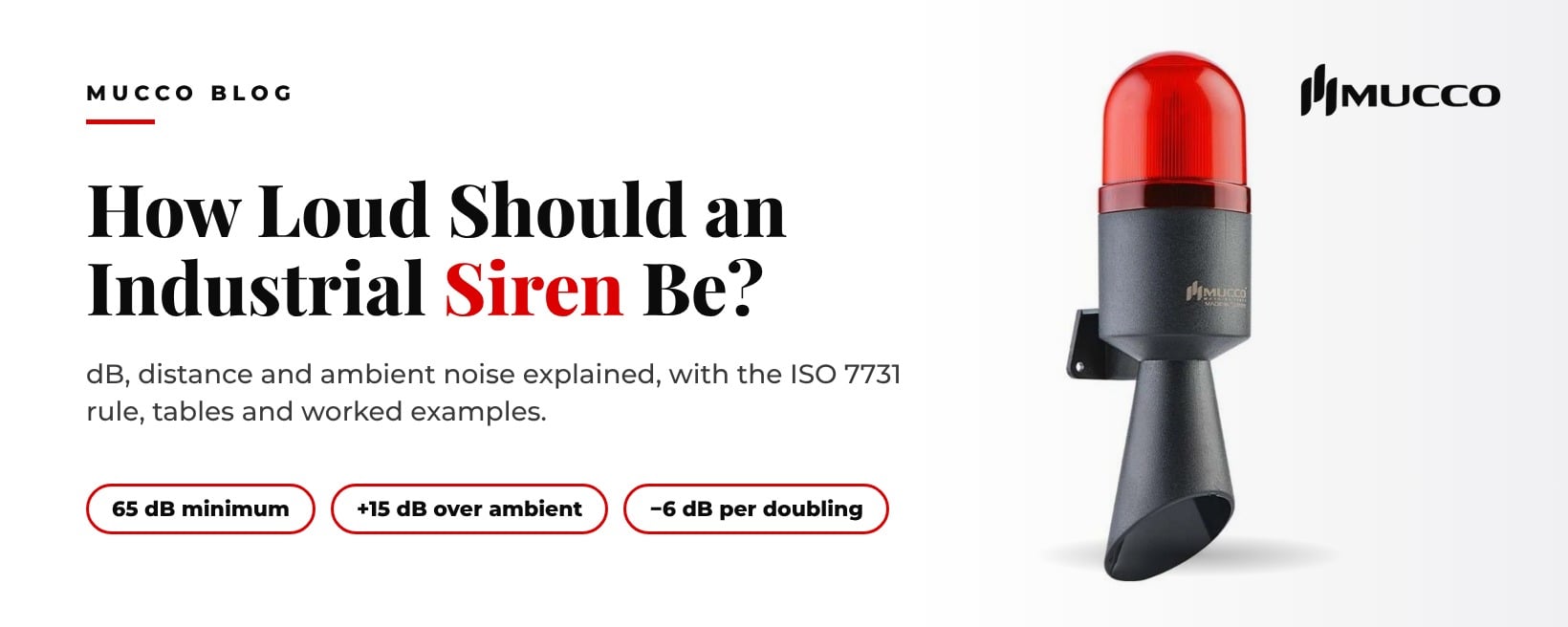
An industrial siren that cannot be heard is decoration. A siren that is far too loud is a hazard of its own. Between those two failures there is a range that can be calculated, and the calculation needs only three inputs: the sound level the device produces at 1 m, the distance to the people who have to hear it, and the ambient noise at the place where they stand.
This guide walks through that calculation for industrial sirens, electronic sounders, сигнальные рожки, alarm horns и sounder beacons. The names differ from market to market, but the acoustics are the same. It covers what the decibel figure on a datasheet means, how level falls with distance, what ISO 7731 asks for, where the upper limit sits, and how to turn all of that into a device choice. It is a starting point for engineering work. It does not replace a site measurement or your own risk assessment.
The short answer
ISO 7731:2003, the international standard for auditory danger signals in public and work areas, gives the most widely used rule. Using the simple A-weighted method, the signal must do two things at every position in the area where it has to be heard [1]:
- It must not be lower than 65 dB (A-weighted).
- It must exceed the A-weighted ambient noise level by more than 15 dB.
The same standard recommends that the signal should not exceed 118 dB(A) in the signal reception area, and that additional visual danger signals are used where the ambient noise is above 100 dB [1].
So the required level is not a property of the siren. It is a property of the place. A 105 dB siren can be more than enough in a packaging hall and useless beside a press line. The rest of this article is about working out which case you are in.
What the dB value on a datasheet tells you
The decibel is a logarithmic unit. A change of 10 dB is a tenfold change in sound intensity, and a change of 20 dB is a tenfold change in sound pressure. That is why small differences in the number matter more than they look: 116 dB is not “a bit more” than 106 dB.
Three details decide whether two datasheet values can be compared.
- The reference distance. A sound level without a distance is incomplete. Most industrial sounders, including the Mucco products mentioned in this article, are specified at 1 m (3.3 ft). Some devices on the market are specified at 10 cm or 30 cm, which makes the number look much higher for the same acoustic output. Always convert to the same distance before comparing.
- The frequency weighting. ISO 7731 works with A-weighted levels in its basic method [1]. A-weighting follows the sensitivity of human hearing and reduces the contribution of low frequencies. If a datasheet does not state the weighting, ask the manufacturer.
- The tone and the setting. Multi-tone sounders do not produce the same level on every tone, and devices with a volume control cover a range. This is why datasheets often give a range such as 105–130 dB instead of one number. Use the level of the tone and setting you will really use.
How sound level falls with distance
In open space, sound from a small source spreads over a growing sphere. The intensity follows the inverse square law, as long as there are no reflections or reverberation [6]. In decibel terms, the level at distance d (in metres) from a source specified at 1 m is:
L(d) = L(1 m) − 20 × log10(d)
Every doubling of distance removes about 6 dB, and every tenfold increase removes 20 dB. The table below applies this to four nominal 1 m levels. The values are free-field estimates for planning. They are not measurements.
| Distance from siren | Loss vs. 1 m | 105 dB at 1 m | 116 dB at 1 m | 127 dB at 1 m | 130 dB at 1 m |
|---|---|---|---|---|---|
| 1 m | 0 dB | 105 дБ | 116 dB | 127 dB | 130 дБ |
| 2 m | 6 dB | 99 dB | 110 дБ | 121 dB | 124 dB |
| 5 m | 14 dB | 91 dB | 102 dB | 113 dB | 116 dB |
| 10 m | 20 dB | 85 dB | 96 dB | 107 dB | 110 дБ |
| 20 m | 26 dB | 79 dB | 90 dB | 101 dB | 104 dB |
| 50 m | 34 dB | 71 dB | 82 dB | 93 dB | 96 dB |
| 100 m | 40 dB | 65 dB | 76 dB | 87 dB | 90 dB |
Why real sites differ from the table
The inverse square law describes an ideal case. Real installations move away from it in both directions.
- Indoors, walls, floors and machines reflect sound. Close to the siren the level follows the table. Further away, reflected sound adds to the direct sound and the level falls more slowly than the table predicts. The same reflections also raise the ambient noise, so the net effect on audibility has to be measured.
- Obstacles such as racking, enclosures, partitions and vehicles block the direct path. A person behind a machine can receive much less than the table suggests.
- Outdoors, air absorption, ground effects, barriers and weather add losses on top of geometric spreading. ISO 9613-2:2024 gives an engineering method for predicting sound pressure levels outdoors at a distance from a source [7]. Use it, or a measurement, for long ranges across a yard, quarry or tank farm.
- Directivity. A horn projects more sound forward than to the sides. The datasheet level is normally the on-axis value, so aim the horn at the area that matters.
Ambient noise decides the target
The ear does not judge a signal by its absolute level. It judges it against the background. A steady background noise masks any signal that sits too close to it in level and in frequency. This is the reason ISO 7731 sets the requirement relative to the ambient noise, and the reason the first job on site is to measure that noise where people actually work, with the machines running in their loudest normal state.
The table shows what the A-weighted method in ISO 7731:2003 leads to for a range of measured ambient levels. The ambient values are examples to show the pattern. Use your own measurements.
| Measured ambient noise, dB(A) | Signal level needed at the listener | Комментарий |
|---|---|---|
| 45 | At least 65 dB | The 65 dB floor applies; ambient + 15 would be only 60 dB |
| 60 | More than 75 dB | Ambient + 15 dB |
| 70 | More than 85 dB | Ambient + 15 dB |
| 80 | More than 95 dB | Ambient + 15 dB |
| 90 | More than 105 dB | Ambient + 15 dB; check exposure of people near the siren |
| 100 | More than 115 dB | Close to the 118 dB(A) recommended maximum |
| Above 100 | Sound alone is not enough | ISO 7731 recommends additional visual danger signals |
The octave-band methods
The +15 dB rule is the simplest of three methods in ISO 7731:2003. The other two compare the signal with the ambient noise band by band. With octave-band analysis, the signal has to exceed the effective masked threshold by at least 10 dB in one or more octave bands. With one-third-octave analysis, the margin is 13 dB [1]. These methods take more measurement work, but they reward a signal whose energy sits where the background is quiet, and they can show that a lower overall level is still clearly audible.
Is 15 dB always necessary?
Żera and Nagórski studied preferred levels of auditory danger signals at the Central Institute for Labour Protection in Warsaw. They concluded that the 15 dB signal-to-noise ratio set by standards is rather conservative [2]. For a designer this is useful in two ways. The 15 dB margin is a safe design target and not a physical threshold, so a small shortfall at the edge of an area does not automatically mean the signal is inaudible. And adding more level beyond what the standard asks for buys little, while it increases the load on the people who stand close to the device.
The upper limit: when a siren is too loud
More decibels are not free. The level that is correct at 30 m is much higher at 1 m, and somebody may be standing there when the alarm starts.
- ISO 7731:2003 states that the maximum signal level should not exceed 118 dB(A) in the signal reception area [1].
- In the United States, OSHA 29 CFR 1910.95 limits permissible exposure to 90 dBA for 8 hours, 95 dBA for 4 hours, 100 dBA for 2 hours, 105 dBA for 1 hour, 110 dBA for half an hour and 115 dBA for a quarter of an hour or less. An 8-hour time-weighted average of 85 dBA is the action level for a hearing conservation program, and impulsive or impact noise should not exceed 140 dB peak [4].
- NIOSH recommends a stricter exposure limit of 85 dBA as an 8-hour time-weighted average [5].
The distance table shows what this means in practice. A device producing 130 dB at 1 m is still at about 118 dB at 4 m in free field. A device producing 116 dB at 1 m is already under 118 dB at the reference distance. If operators work within a few metres of the mounting point, a very powerful siren is the wrong tool. Several smaller sounders spread across the area give a more even level, with nobody standing in a hot spot. A sounder with a volume potentiometer also helps, because the level can be set during commissioning with a sound level meter instead of being fixed by the catalog number.
Loudness is not the only requirement
A loud signal that people cannot identify is not a working alarm. OSHA 29 CFR 1910.165 requires that an employee alarm is capable of being perceived above ambient noise or light levels by all employees in the affected portions of the workplace, and that it is distinctive and recognizable as a signal to evacuate or to perform the actions in the emergency action plan [3]. The regulation does not give a decibel number. It gives a result that has to be achieved.
Three design choices support that result.
- Frequency. The first edition of ISO 7731 recommended basing the danger signal on frequencies in the 300 Hz to 3,000 Hz range [2]. A signal with energy in that range, and with a spectrum that differs from the dominant machine noise, is easier to detect than a pure tone sitting inside the noisiest band.
- Tone pattern. Sweeping, alternating and pulsed tones stand out from steady machinery noise. Multi-tone sounders let you assign different sounds to different events, for example one tone for a process alarm and another for evacuation. ISO 7731 points to ISO 8201 for emergency evacuation signals and to ISO 11429 for systems of auditory and visual danger signals [1]. Keep the number of different signals small enough for people to remember.
- Light with sound. Where ambient noise is very high, where hearing protection is worn, or where some people on site have reduced hearing, add a visual signal. ISO 7731 recommends this explicitly above 100 dB of ambient noise [1]. A Светодиодный звуковой сигнал or a сигнальный маяк next to the sounder covers both channels. For the color to use, see our guide to stack light colors and their meaning.
A six-step sizing method
- Define the signal reception area. Mark on a layout where people must be able to hear the alarm. Include walkways, control rooms, enclosed cabins and outdoor zones if they belong to the same alarm.
- Measure the ambient noise. Take A-weighted readings at representative positions with the process running. Record the highest normal value for each zone.
- Set the target at the listener. Target = ambient + 15 dB, with a floor of 65 dB. If the target is close to or above 118 dB(A), plan visual signals and more, smaller devices.
- Find the longest distance. For each planned mounting point, find the furthest listening position it has to cover and check for obstacles in the path.
- Calculate the 1 m level needed. Required level at 1 m = target + 20 × log10(distance in metres). Add a reserve for obstacles and for the tone you will use. Then check the nearest listening position against the upper limit.
- Verify on site. After installation, measure the signal at the furthest and nearest positions with the plant running, and carry out a listening test with the people who work there, including those who wear hearing protection.
Worked example 1: assembly hall
The measured ambient noise is 78 dB(A). The target at the listener is more than 93 dB. The furthest workstation is 12 m from the planned mounting point. The loss over 12 m is 20 × log10(12) = 21.6 dB, so the siren must deliver more than about 115 dB at 1 m on the selected tone, before any reserve. At the nearest workstation, 3 m away, the level would be about 105 dB, which is below the 118 dB(A) recommendation. A compact sounder at the top of its range, or a mid-range horn with a few decibels in hand, fits this case.
Worked example 2: outdoor loading yard
The ambient noise with trucks moving is 85 dB(A). The target is more than 100 dB at the listener. One siren is supposed to cover 40 m. The loss over 40 m is 32 dB in free field, so the device would need more than 132 dB at 1 m, and it would produce about 118 dB at 5 m. Outdoor losses come on top of that [7]. One device cannot do this job well. Three or four horns at 125–130 dB, each covering 15 to 20 m and combined with a warning light, give the required level with less exposure near each device.
What about two sirens side by side?
Two equal sounders at the same position add about 3 dB, not double the reading. Doubling the number of devices in one place is therefore a weak way to gain range. Moving a device closer to the listeners is much more effective: halving the distance gains 6 dB.
Matching the result to a device
The values below are taken from the Mucco product pages on the date of writing. All are stated at 1 m (3.3 ft), and all of these products are listed with IP65 protection. Check the current datasheet before you specify.
| Product | Sound level at 1 m | Tones | Where it tends to fit (general guidance) |
|---|---|---|---|
| Mini Electronic Siren | 103–116 dB | 2 (continuous or intermittent) | Machines, control panels and small cells |
| Электронная сирена Nut-Connect Mini | 103–116 dB | 2 (continuous or intermittent) | Nut-mounted version of the mini siren |
| Surface Mounting Short Warning Horn | 95–127 dB | 2, wire controlled | Machine and line alarms |
| Настенное крепление электронной сирены | 105–130 dB | 2, 7 or 16 depending on version | Workshops, halls and warehouses |
| Universal Warning Horn with 16 Tones | 124–130 dB, adjustable with potentiometer | 16, selected with internal button | Sound and LED light in one device |
| Universal LED Warning Horn with 16 Tones | 95–127 dB, adjustable with potentiometer | 16, selected with internal button | Combined signal where the level has to be set on site |
| Сверхмощный предупреждающий звуковой сигнал серии EB120 | 125–133 dB | 7, wire controlled | Large halls, yards and outdoor plant |
The full ranges are in the электронные сирены, сигнальные рожки и heavy-duty warning lights and horns categories. For background on tone selection and combined devices, see our guide to warning horns and sounder beacons и guide to LED audio-visual alarms. Examples of installed devices are on the applications page.
Common mistakes
- Buying by the biggest number. The highest dB value in the catalog is not the safest choice. It is the right choice only when the distance and the ambient noise call for it.
- Comparing levels at different distances. A value at 10 cm and a value at 1 m differ by 20 dB for the same device.
- Measuring ambient noise with the line stopped. The alarm has to work on the loudest normal day.
- Forgetting enclosed spaces. Cabins, control rooms and forklift cabs need their own check, and often their own sounder or light.
- Mounting too low or behind an obstacle. A clear line from the horn to the listeners is worth several decibels.
- One tone for everything. If every event sounds the same, people stop reacting. Assign tones deliberately and train them.
- No test after installation. A calculation is a plan. A measurement and a listening test are the proof.
Часто задаваемые вопросы
How many decibels should an industrial siren have?
Enough to be more than 15 dB above the ambient noise and at least 65 dB at every position where it must be heard, following the A-weighted method in ISO 7731:2003 [1]. The 1 m level you need then depends on the distance: add 20 × log10(distance in metres) to the target.
What does “dB at 1 m” mean?
It is the sound pressure level measured 1 m from the device, normally on its axis. It is a reference point for calculation, not the level people will receive at their workplace.
How far can a 120 dB siren be heard?
That depends on the ambient noise. In free field, a 120 dB at 1 m device gives about 100 dB at 10 m, 94 dB at 20 m and 80 dB at 100 m. With 70 dB(A) of ambient noise, the +15 dB target of 85 dB is met out to roughly 56 m in ideal conditions. With 85 dB(A) of ambient noise, the same device meets the target only to about 10 m.
Can an alarm be too loud?
Yes. ISO 7731:2003 recommends that the signal should not exceed 118 dB(A) in the signal reception area [1], and occupational noise rules limit how long people may be exposed to high levels [4][5]. Place powerful sirens away from permanent workstations or use more, smaller devices.
Are two sirens twice as loud as one?
No. Two equal sounders at the same place add about 3 dB. Spreading devices across the area is more effective than grouping them.
What is the difference between an electronic siren, a sounder and a warning horn?
In everyday use the terms overlap. Electronic sirens and sounders generate the tone electronically and often offer several tones. A warning horn uses a horn-shaped outlet to direct the sound. The selection method in this article applies to all of them, as well as to combined sounder beacons.
Do I need a light as well as a siren?
If the ambient noise is above 100 dB, ISO 7731 recommends additional visual danger signals [1]. A light is also good practice where hearing protection is worn. A stack light with a buzzer module or a LED warning horn combines both.
Which standard should I follow?
ISO 7731 is the international reference for auditory danger signals. National rules such as OSHA 29 CFR 1910.165 in the United States [3], fire alarm codes and sector rules may add requirements. Check what applies to your site and your product.
Summary
Measure the ambient noise. Add 15 dB, with a floor of 65 dB, to get the target at the listener. Add the distance loss to get the level needed at 1 m. Check the nearest position against the 118 dB(A) recommendation. Add a light where noise is high. Then verify on site. With those steps, the choice of siren follows from the plant and not from the biggest number in the catalog.
If you would like help selecting a siren, warning horn or sounder beacon for your machine or site, send your ambient noise level, coverage distance and supply voltage to sales@muccosignal.com and ask for a quotation.
References
- International Organization for Standardization (2003). ISO 7731:2003 Ergonomics — Danger signals for public and work areas — Auditory danger signals (2nd ed.). Geneva: ISO. https://www.iso.org/standard/33590.html
- Żera, J., & Nagórski, A. (2000). Preferred levels of auditory danger signals. International Journal of Occupational Safety and Ergonomics, Special Issue, 111–117. Central Institute for Labour Protection, Warsaw. Full text (BazTech)
- Occupational Safety and Health Administration. 29 CFR 1910.165 Employee alarm systems. U.S. Department of Labor. https://www.osha.gov/laws-regs/regulations/standardnumber/1910/1910.165
- Occupational Safety and Health Administration. 29 CFR 1910.95 Occupational noise exposure, Table G-16. U.S. Department of Labor. https://www.osha.gov/laws-regs/regulations/standardnumber/1910/1910.95
- National Institute for Occupational Safety and Health (1998). Criteria for a Recommended Standard: Occupational Noise Exposure, Revised Criteria 1998. DHHS (NIOSH) Publication No. 98-126. https://stacks.cdc.gov/view/cdc/6376
- Nave, R. Inverse Square Law, Sound. HyperPhysics, Georgia State University. http://hyperphysics.phy-astr.gsu.edu/hbase/Acoustic/invsqs.html
- International Organization for Standardization (2024). ISO 9613-2:2024 Acoustics — Attenuation of sound during propagation outdoors — Part 2: Engineering method for the prediction of sound pressure levels outdoors (2nd ed.). Geneva: ISO. https://www.iso.org/standard/74047.html