












Stack Lights: The Complete Guide to Industrial LED Signal Towers and Andon Lights
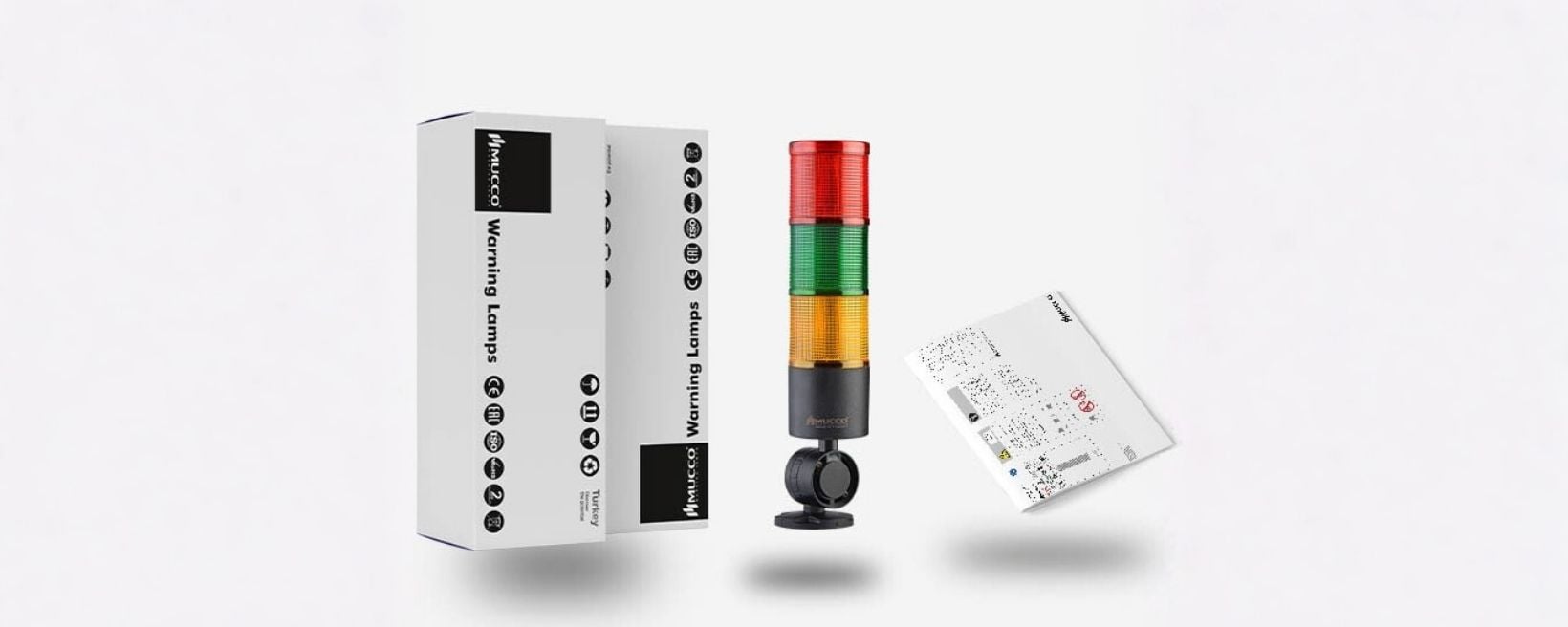
Stack lights are among the most effective visual communication devices used in modern factories, automated production lines and industrial machinery. By combining multiple colored LED modules in a vertical tower, a stack light allows operators, maintenance teams and production managers to understand machine status from a distance.
A green segment may indicate normal production, yellow may request attention and red may show that a machine has stopped. Additional blue, white or audible modules can communicate maintenance requests, material shortages, quality checks and other process conditions. Because the information is immediate and highly visible, industrial stack lights can help teams react faster without repeatedly checking an HMI or walking directly to the control panel.
Mucco offers a broad selection of industrial stack lights and modular signal towers with different numbers of layers, mounting options, voltage ranges, light modes and audible alarm configurations. This guide explains what stack lights are, how they work, what their colors mean and how to select the correct LED signal tower for your machinery.
In this guide:
- What is a stack light?
- Stack lights, tower lights and Andon lights
- Stack light color meaning
- Choosing the number of layers
- Modular versus fixed stack lights
- 24V, 110V, 120V and industrial voltage options
- Stack lights with sound
- Mounting, visibility and protection
- Industrial applications
- Stack light selection checklist
- Frequently asked questions
What Is a Stack Light?
A stack light is a vertical signaling device made from one or more illuminated sections arranged on top of each other. Each section can normally be controlled independently, allowing the tower to display different machine or process conditions.
Stack lights are also commonly described as:
- Signal tower lights
- Industrial tower lights
- Machine status lights
- Andon lights
- Indicator towers
- Stackable signal lights
- Tower stack lights
- Industrial signal lights
Although manufacturers and countries may use different terms, these products perform a similar function: they convert electrical control signals into clear visual or audiovisual information.
A typical industrial stack light contains red, yellow and green modules. More advanced systems may include blue and white sections, flashing or strobe modes and an integrated buzzer. The individual sections are connected to PLC outputs, relays, switches, sensors or another machine controller.
When the status of the machine changes, the control system activates the relevant section. An operator can then understand the condition of the equipment without opening the control cabinet or reading a detailed diagnostic screen.
Are Stack Lights, Signal Tower Lights and Andon Lights the Same?
The terms are closely related but may describe slightly different applications.
Stack light is the most widely used general term for a tower containing multiple colored signal modules. The variations “stacklight,” “stacklights” and “stack light” are also used in product searches and technical documents.
Signal tower light or industrial signal tower light emphasizes the physical tower construction and its signaling function.
Andon light usually refers to a stack light used as part of an Andon or visual management system. In this application, operators may activate a light to request assistance, materials, maintenance support or a quality inspection.
Machine stack light generally describes a unit mounted directly on a CNC machine, packaging machine, robot cell, conveyor or other production equipment.
In practice, the same LED tower may be used as a machine status light, an Andon light or a production warning indicator. The important difference is not the name of the product but the logic used to activate each color.
For workstations and visual production systems, explore Mucco’s Andon kit stack light solutions. For a detailed explanation of visual management, you can also read our guide to industrial Andon systems and visual management.
Why Are Industrial Stack Lights Important?
Industrial processes generate large amounts of information. Temperatures, pressure values, cycle times, alarms, sensor conditions and production counts may all appear on a machine interface. However, an operator standing several meters away cannot continuously monitor every screen.
Stack lights reduce this information into a simple visual message that can be recognized quickly. They are particularly valuable in factories where one employee supervises multiple machines or where maintenance personnel must identify the source of an alarm from across the production area.
A properly designed stack lighting system can support several operational goals:
- Faster fault recognition: A red or flashing light helps personnel locate stopped equipment quickly.
- Improved production visibility: Supervisors can see whether machines are running, waiting or stopped.
- Standardized communication: Consistent colors reduce confusion between different machines and production areas.
- Reduced unnecessary movement: Employees do not have to approach each HMI to check basic machine status.
- Better maintenance response: Blue or white modules can be assigned to requests for technical support.
- Support for visual management: Andon lights make abnormalities visible at the point where they occur.
Stack lights should be treated as communication devices rather than physical machine guards. They may improve awareness, but they do not replace guards, interlocks, emergency-stop systems or other protective measures required by the machine risk assessment. The OSHA machine-guarding guidance provides useful background on protecting employees from mechanical hazards.
Stack Light Color Meaning and Common Color Standards
One of the most frequent questions about signal towers is: What do stack light colors mean?
There is no single color sequence that is automatically correct for every factory. The meaning of each color should be documented according to the machine design, risk assessment, company procedures and applicable standards. Nevertheless, several common conventions are used throughout industrial automation.
| Color | Common meaning | Typical example |
|---|---|---|
| Red | Danger, serious fault or stopped condition | Emergency condition, safety fault or production stop |
| Yellow or amber | Warning or abnormal condition | Low material, rising temperature or attention required |
| Green | Normal or satisfactory condition | Machine running normally or ready for operation |
| Blue | Mandatory action or assistance request | Maintenance, material or operator support requested |
| White or clear | Neutral or user-defined information | Quality check, setup mode or custom production state |
The IEC 60073 standard establishes general coding principles for visual, acoustic and tactile indicators and actuators. Machine builders should review the relevant standards and define a written color philosophy for their equipment.
Consistency is more important than adding as many colors as possible. When red means “machine fault” on one line but “material required” on another, personnel may hesitate or respond incorrectly. A factory-wide stack light color standard should therefore specify:
- The meaning of every color
- Whether each color is steady or flashing
- Which conditions activate the audible alarm
- Who is responsible for responding
- How the signal is reset
- Whether multiple colors can operate simultaneously
How Many Stack Light Layers Do You Need?
Stack lights are commonly available with one to five illuminated layers. Selecting the correct number of layers helps keep the signal clear while providing enough information for the application.
One-Layer Stack Lights
A one-layer stack light is suitable when only one important condition must be shown. A red-only light, for example, may indicate a machine fault, blocked access point or process alarm.
These compact or miniature stack light configurations are often used on small machines, test equipment, control panels and simple workstations. View available one-layer stack lights.
Two-Layer Stack Lights
A two-layer tower is a practical choice for basic status indication. Common combinations include:
- Green for running and red for stopped
- Green for available and yellow for attention
- Red for alarm and blue for assistance request
Mucco’s two-layer stack lights are available with different mounting and extension options.
Three-Layer Stack Lights
The red-yellow-green three-layer configuration is one of the most recognizable arrangements in industrial automation. It communicates normal operation, warning and fault conditions without adding unnecessary complexity.
A three-layer LED stack light is often appropriate for CNC equipment, packaging machinery, conveyors, assembly stations and robotic cells. Browse three-layer stack light models.
Four-Layer Stack Lights
A fourth layer is useful when the machine needs to communicate an operator call, maintenance request, quality hold or special production mode in addition to the standard red, yellow and green conditions.
For example, blue may indicate that an operator has requested maintenance while the remaining colors continue to display the machine state. See four-layer industrial stack lights.
Five-Layer Stack Lights
Five-layer stack lights provide the greatest number of independently controlled visual states. They can be useful on complex production systems, but every layer should have a clear and necessary purpose.
Too many simultaneously active colors can make the tower difficult to interpret. Use a five-layer system when personnel genuinely need several separate status categories. Explore five-layer signal towers.
Modular Stack Lights Versus Preconfigured Stack Lights
Another important decision is whether to select a modular stack light or a preconfigured tower.
Modular Stack Lights
A modular stack light is assembled from separate body, light, buzzer and mounting components. Depending on the product family, the number and order of the modules can be changed according to the machine requirements.
Modular designs are particularly valuable when:
- Machines require different color combinations
- Future expansion is expected
- A damaged module should be replaced separately
- Different buzzer or mounting options are needed
- One product platform will be used across several machine models
Mucco’s 50 Series modular stack light range includes separate light, buzzer and installation components. Selected models also support an M12 connector, helping machine builders create repeatable and serviceable connections.
For example, the 50 Series three-layer modular stack light with an M12 8-pin connector is offered with different voltage and buzzer options. Its compact design is suitable for machinery where space, rapid connection and flexible configuration are important.
Preconfigured or Fixed Stack Lights
A preconfigured stack light is supplied in a defined layer arrangement. It may be the most efficient option when the machine design is already standardized and no future reconfiguration is expected.
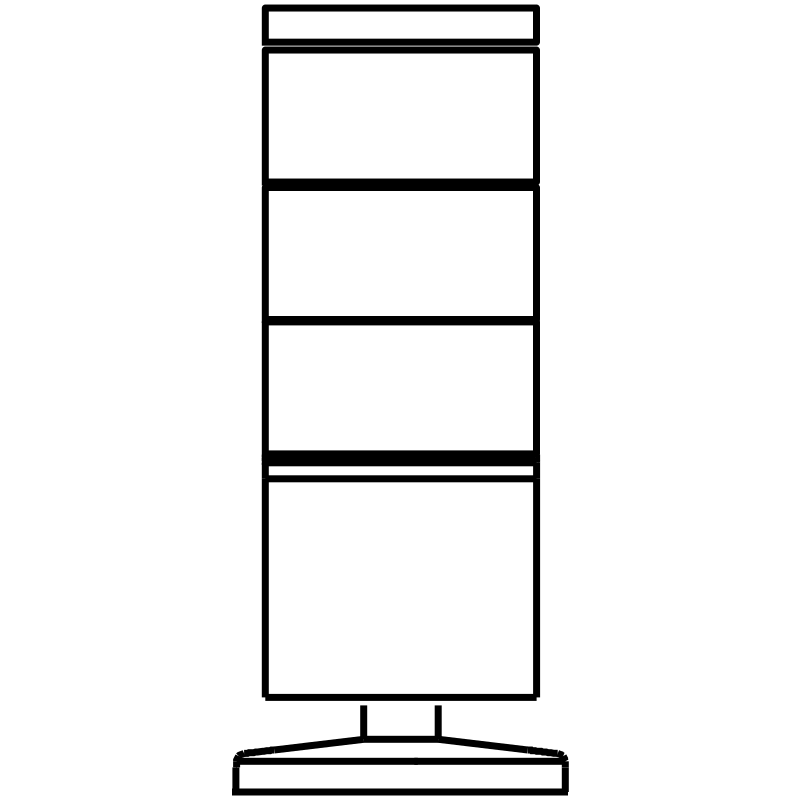
Fixed stack lights can simplify model selection for repetitive production. Mucco offers surface, wall and foldable-base configurations with various extension lengths. One example is the surface-mounted four-layer stack light without an extension tube.
The best approach depends on the machine lifecycle. A modular signal tower may reduce long-term spare-part complexity, while a preconfigured light may offer a straightforward solution for a stable design.
Why LED Stack Lights Are the Industrial Standard
Older signal towers sometimes used incandescent lamps or other replaceable light sources. Most modern industrial stack lights now use LED technology because LEDs provide several practical advantages:
- Long operating life
- Low energy consumption
- Fast response
- Resistance to repeated switching
- Compact construction
- Clear and saturated colors
- Reduced lamp replacement requirements
An LED stack light can operate for long periods without the routine bulb replacement associated with older technologies. This is especially important when the tower is installed above a large machine or in an area that is difficult to access.
LEDs also support multiple signaling modes. Depending on the model, the same industrial tower light may provide steady, flashing, rotary-style or strobe effects. The selected mode should match the urgency of the condition without creating unnecessary visual distraction.
A steady green signal is normally appropriate for a stable running condition. A flashing yellow light may indicate a temporary warning, while a flashing red light and audible alarm may be reserved for a more urgent fault.
Choosing a 24V, 110V, 120V or High-Voltage Stack Light
Supply voltage is one of the most important technical specifications when choosing stack lights. The selected voltage must be compatible with the machine control system and the output devices used to activate the modules.
24V Stack Lights
A 24V stack light is commonly used in industrial automation because many PLCs, sensors, relays and control circuits operate at 24V DC. Low-voltage control also simplifies integration with transistor outputs and distributed I/O modules.
A 24V DC stack light may be the preferred choice when:
- The PLC outputs supply or switch 24V DC
- The signal tower is mounted directly on a machine
- The control cabinet already includes a 24V power supply
- Fast semiconductor switching is required
- The machine builder wants a common control voltage
Always check whether the product accepts DC only or both AC and DC. The nominal voltage alone does not confirm polarity, internal protection or compatibility with a particular PLC output.
110V and 120V Stack Lights
A 110V or 120V stack light may be used in machines and facilities where those control voltages are standard. These versions are frequently selected for retrofit projects or control systems based on relay outputs.
Before connecting a 110V stack light, verify the exact voltage range, frequency, current consumption and wiring requirements shown in the technical documentation.
220V, 230V and Wide-Range Stack Lights
Higher-voltage models may be practical when a local low-voltage supply is not available or when the existing equipment already uses mains-rated control circuits.
Some industrial stack lights use a wide input range, such as 40–250V AC/DC or 85–250V AC/DC. Wide-range products can simplify inventory for machine builders selling equipment to different markets. However, the switching components, cables and installation method must still be rated correctly for the application.
Only qualified personnel should design and perform electrical connections. Product datasheets, local electrical rules and the complete machine safety design must always take priority over general wiring examples.
When Should You Use Stack Lights With Sound?
Visual signals are most effective when personnel can see the tower. In a large production hall, an employee may be facing another direction, working behind an enclosure or monitoring several machines. A stack light with an audible alarm can attract attention even when the visual indicator is outside the direct field of view.
Stack lights with sound are useful for:
- Critical machine faults
- Cycle-complete notifications
- Material requests at assembly stations
- Process timeout alarms
- Maintenance calls
- Areas where operators move between multiple machines
The sound level should be evaluated against the background noise at the installation location. A buzzer that is clearly audible in an office may be difficult to hear beside compressors, presses or machining equipment.
At the same time, louder is not always better. Excessive or constantly active alarms can cause discomfort and alarm fatigue. The sound pattern, intensity and duration should communicate urgency without becoming routine background noise.
Consider the following questions:
- Which conditions require both light and sound?
- Can personnel identify which machine generated the alarm?
- Should the sound stop when acknowledged while the light remains active?
- Is a pulsed tone more recognizable than a continuous tone?
- Does the ambient noise require a separate high-output warning horn?
For very loud environments, a separate LED warning horn or industrial audible device may be more suitable than a compact integrated buzzer.
Mounting Style, Viewing Distance and Environmental Protection
Even the brightest stack light will not perform well if it is hidden behind a cabinet, installed below the operator’s normal sight line or blocked by moving equipment. Placement should be considered during the machine design rather than after the equipment is completed.
Surface Mounting
Surface-mounted stack lights are installed directly on top of the machine or enclosure. They provide a compact appearance and are suitable when the installation surface is already visible from the working area.
Tube or Extension Mounting
An extension tube raises the tower above the machine body, helping the signal remain visible over guards, doors and nearby equipment. Different tube lengths can be selected according to the machine height and viewing angle.
Wall or Side Mounting
A wall bracket allows the signal tower to be installed on the side of a cabinet, column or machine frame. This is useful when there is no suitable horizontal mounting surface.
Foldable-Base Mounting
A foldable base can help protect the stack light during transportation or in areas where accidental impact is possible. It may also simplify packaging for machine manufacturers shipping completed equipment.
Environmental conditions should be evaluated together with the mounting style. Important factors include:
- Dust and airborne particles
- Water spray and cleaning procedures
- Humidity and condensation
- Oil mist and chemical exposure
- Ambient temperature
- Direct sunlight and ultraviolet radiation
- Vibration and mechanical impact
Review the product’s IP rating and manufacturer documentation rather than assuming every stackable light has the same protection. Mucco publishes relevant certificates, declarations and test documentation for its signaling product families.
Where Are Industrial Stack Lights Used?
Industrial stack lights are used anywhere personnel need to recognize equipment status quickly. Their simple control principle allows them to work with new automation systems as well as older machinery.
CNC Machines and Machine Tools
A machine stack light can show whether a CNC program is running, paused, completed or stopped by a fault. Maintenance teams can identify a stopped machine from across the workshop and respond without checking every control screen.
Packaging and Filling Lines
Packaging equipment may use LED stack lights to indicate low material, open guards, conveyor jams, rejected products or a completed batch. A buzzer can be added when immediate operator action is required.
Assembly Lines and Andon Stations
Andon lights allow operators to request materials, technical assistance or quality support without leaving their workstation. The signal can be activated through a push button, pull cord, sensor, PLC or production management system.
Robotic Cells
Robot cells can use a signal tower to communicate automatic mode, manual mode, cycle operation, waiting status or a safety-related stop. The color logic should match the complete cell design and operating instructions.
Injection Molding and Process Machinery
Industrial stack lights can indicate heating, ready, production, cooling and alarm conditions. Their wide viewing angle helps employees monitor several machines in the same production area.
Conveyors and Material Handling
Signal tower lights are frequently used to show conveyor availability, blockage, overload or emergency-stop status. Audible signals may warn personnel before equipment starts or restarts where required by the system design.
Warehouses and Logistics Facilities
Stack lights can be integrated into sorting equipment, automated storage systems, loading stations and picking workstations. Different colors may show available, processing, full, waiting or fault states.
Laboratories and Test Equipment
A miniature stack light can provide clear status indication on test benches, inspection systems and laboratory equipment without occupying the space required by a full-size industrial tower.
Building and Facility Systems
Stackable lights may also communicate the condition of pumps, generators, access systems, HVAC equipment or utility controls. In these applications, the selected enclosure and protection class should match the environment.
For more examples, visit Mucco’s industrial signaling applications and industries served pages.
Stack Lights in Lean Manufacturing and Visual Management
Visual management aims to make the current condition of a process understandable without requiring a detailed report. Stack lights support this goal by displaying abnormalities where they occur.
In an Andon system, a workstation may use:
- Green to indicate normal production
- Yellow to indicate a developing problem
- Red to indicate that production has stopped
- Blue to request materials or maintenance
- White to request a quality inspection
The signal itself does not solve the problem. Its value comes from the response process built around it. A successful Andon system defines who receives the call, how quickly they should respond and how the root cause is recorded.
For this reason, installing tower lights without defining responsibilities often produces limited results. Before deploying an Andon light system, document:
- The conditions that operators can report
- The person or department responsible for each condition
- The expected response time
- The escalation method
- The reset and acknowledgment procedure
- The data that should be recorded for improvement
Stack Lights and Industry 4.0
Stack lights are simple devices, but they can still play a role in connected manufacturing. PLCs and monitoring systems can record the same signals used to activate the light modules, allowing facilities to analyze machine availability, waiting time, faults and response performance.
Legacy machines that do not have a modern communication interface can also be monitored through external sensors or machine-vision systems. Academic research into the detection and classification of industrial signal lights has demonstrated how camera systems can identify the operating condition represented by factory signal towers under specified test conditions.
This creates a practical bridge between visual factory communication and digital production monitoring. The stack light remains useful to employees on the factory floor while the underlying signal data can be transferred to dashboards, maintenance systems or production databases.
Basic Stack Light Wiring and Control Concepts
The exact wiring method depends on the product model. Some stack lights use individual wires for each color, while modular products may use terminal blocks, connectors or dedicated body modules.
A common arrangement includes:
- One common supply connection
- One control connection for each light module
- One additional connection for the buzzer
Each PLC output, relay contact or switch activates a corresponding section. Depending on the product design, the controller may switch the positive supply, negative supply, phase or neutral conductor.
Before installation, confirm:
- Nominal and permitted voltage range
- AC or DC compatibility
- Required polarity
- Maximum current consumption
- Common-positive or common-negative wiring
- Connector pin assignment
- PLC output type and current capacity
- Need for an interface relay
- Fuse or circuit protection requirements
- Cable length and conductor size
Do not determine the wiring method from wire colors alone. Always use the specific wiring diagram supplied for the selected product.
How to Choose the Right Stack Light
Use the following checklist when comparing industrial stack lights:
1. Define the Conditions to Display
Write down every status that personnel genuinely need to see. Normal operation, standby, warning, fault, material request and maintenance request are common examples.
2. Assign the Colors
Use a documented color scheme that is consistent with the rest of the facility. Avoid assigning several unrelated meanings to the same color.
3. Select the Number of Layers
Choose one to five layers according to the required status information. Do not add layers that have no defined purpose.
4. Choose Modular or Preconfigured Construction
Select a modular stack light when flexibility and replaceable modules are important. Choose a fixed configuration for standardized machinery with stable requirements.
5. Confirm the Supply Voltage
Match the signal tower to the PLC, relay system or local supply. Confirm whether the product supports 24V DC, 12–24V AC/DC, 110V, 120V, 220V or a wide industrial input range.
6. Decide Whether Sound Is Required
Measure or estimate the background noise and determine which alarms require an audible signal. Consider whether a compact buzzer or separate warning horn is more appropriate.
7. Select the Light Mode
Use steady light for normal or persistent information. Reserve flashing and strobe modes for conditions that require increased attention.
8. Choose the Mounting Method
Check the available surface, viewing angles and risk of impact. Select direct surface, extension tube, wall bracket or foldable-base mounting.
9. Review the Environment
Confirm the IP protection, temperature range, lens material and resistance to dust, water, UV exposure or chemicals.
10. Check Visibility
Consider machine height, ambient lighting and viewing distance. A compact tower may be sufficient for a workstation, while a larger industrial stack light may be needed in a wide production hall.
11. Review Service and Spare Parts
Check whether light modules, buzzers, connectors, bases and brackets can be replaced separately. Standardizing one modular family across machines can simplify spare-parts inventory.
12. Verify Documentation
Review technical datasheets, wiring diagrams, dimensions, certificates and declarations before finalizing the machine design.
Common Stack Light Selection Mistakes
Avoiding a few common mistakes can significantly improve the effectiveness of a signal tower system.
Using Too Many Colors
More layers do not automatically create a better system. If operators cannot remember the meaning of each color, the tower becomes decorative rather than informative.
Using Different Meanings on Similar Machines
Color definitions should remain consistent whenever possible. Employees should not have to relearn the signal logic every time they move to another line.
Installing the Light Where It Cannot Be Seen
Check visibility with doors open and closed and with employees standing at their actual working positions. Nearby machines, racks and guards may block the signal.
Selecting Sound Without Measuring Background Noise
An underpowered buzzer may be missed, while an unnecessarily loud alarm can create discomfort. Select the sound level according to the real environment.
Ignoring the PLC Output Type
A product with the correct nominal voltage may still be incompatible with the output circuit. Confirm current capacity, switching method and common connection.
Treating a Stack Light as a Safety Device
A tower light communicates status but does not normally prevent access to a hazard. It must not replace required guarding, interlocks or validated safety controls.
Why Choose Mucco Industrial Stack Lights?
Mucco provides a wide range of stack lights for machine builders, system integrators, industrial facilities and production equipment manufacturers.
The Mucco modular and stack light category includes:
- One-layer through five-layer stack lights
- Modular 50 Series signal towers
- Industrial Andon kit solutions
- Surface-mounted configurations
- Wall-mounted configurations
- Foldable-base options
- Different extension lengths
- Optional audible modules
- Multiple voltage ranges
- Steady, flashing, rotary-style and strobe light modes on selected models
This range allows machine designers to select a configuration based on visibility, control voltage, installation space and process complexity rather than adapting the machine to a single standard tower.
Customers planning bulk, project-based or customized requirements can contact Mucco Signal for model selection and quotation support.
Frequently Asked Questions About Stack Lights
What is a stack light?
A stack light is an industrial signaling device containing one or more colored light modules arranged vertically. Each module indicates a different machine, process or workstation condition.
What is another name for a stack light?
Stack lights are also called signal tower lights, tower lights, industrial indicator lights, machine status lights, Andon lights and stackable signal towers. “Stacklight” and “stacklights” are common spelling variations.
What do stack light colors mean?
Commonly, red indicates a serious fault or stopped condition, yellow indicates a warning, green indicates normal operation, blue indicates an action or assistance request and white is used for neutral or custom information. The final meanings must be defined by the machine designer and documented for personnel.
Which modular stack light is best?
The best modular stack light is the model that matches the required number of conditions, voltage, mounting method, viewing distance, sound level and environmental protection. A three-layer red-yellow-green tower is suitable for many machines, but more complex applications may require additional modules.
How do I choose the right tower light?
Start by listing the conditions you need to display. Then select the color sequence, number of layers, voltage, sound option, light mode, mounting method and protection class. Finally, verify the wiring method and PLC compatibility.
Should I choose a 24V stack light?
A 24V stack light is usually a good choice when the machine uses a 24V PLC and control power supply. Confirm whether the selected model requires AC, DC or supports both.
Can a stack light operate on 110V, 120V or 220V?
Yes. Industrial tower lights are available in different voltage ranges, including low-voltage and mains-voltage options. Always verify the exact product specification before connection.
Can stack lights include an audible alarm?
Yes. Many stack lights offer an integrated buzzer or sound module. Separate high-output warning horns can also be used when a louder or more directional alarm is necessary.
What is the difference between a stack light and a signal beacon?
A stack light normally communicates several different machine states through independently controlled colored layers. A signal beacon generally provides one primary warning condition using a single illuminated body. Read our signal beacons and stack lights selection guide for a more detailed comparison.
Are Andon lights the same as stack lights?
An Andon light is usually a stack light used within a visual management or assistance-request system. The hardware may be similar, but the Andon process also includes response rules, escalation and production improvement activities.
How high should a stack light be mounted?
It should be high enough to remain visible from the required working positions but not so exposed that it is easily damaged. Machine height, nearby equipment, viewing distance and ceiling conditions should all be considered.
Can stack lights be connected directly to a PLC?
Many models can be controlled by PLC digital outputs, but compatibility depends on voltage, current, common wiring and output type. An interface relay may be required in some systems.
Do stack lights improve machine safety?
They can improve awareness and communication, but they do not normally replace physical guards, safety interlocks, emergency-stop circuits or other risk-reduction measures.
Build a Clearer Industrial Signaling System
Stack lights provide a simple and effective way to make machine status visible. When their colors, sound patterns and response procedures are designed correctly, they help operators and maintenance teams recognize abnormalities, locate stopped equipment and respond more efficiently.
The correct solution may be a compact one-layer indicator, a standard three-color machine stack light, a five-layer Andon tower or a configurable modular stack light with an audible alarm. The selection should always be based on the information that personnel need, the machine control voltage and the physical installation environment.
Explore the complete Mucco industrial stack lights and modular LED signal tower range to compare layer counts, mounting methods, voltage options and sound configurations.
For customized machines, bulk quantities or international projects, contact Mucco Signal for product selection and quotation support.